Filoxenia: When a Stranger Feels at Home
There is a feeling that many people describe when they come to Crete for the first time: it feels strangely like coming home.
It’s difficult to explain. How can a place you have never lived in, perhaps never even visited before, feel familiar? Maybe it’s the landscape, the pace of life, the warmth of the people, or the simple pleasure of sitting at a table with good food and nowhere you need to be.
For me, I think it’s partly because of my family ties to Greece, but also because that feeling comes from a Greek tradition that has existed for thousands of years: philoxenia.
Filoxenia is a Greek word often translated simply as hospitality. But the meaning goes much deeper than that. Literally, it can be understood as a love or kindness toward the stranger, and in Greece, it is a tradition deeply woven into the culture.
In The Odyssey, there are frequent references to what is sometimes described as Zeus’s law of hospitality: the sacred obligation to welcome strangers, offer them food and shelter, and treat them with kindness. A stranger arriving at your door was not to be turned away.
The roots of this idea go back to Greek mythology. There was always the possibility that the stranger standing at your door could be a god in disguise. In showing hospitality to them, you were, in effect, showing respect to the gods themselves. Zeus, as protector of guests and strangers, was closely associated with this sacred tradition of hospitality.
It is an idea that plays an important role in The Odyssey. When Odysseus finally returns to Ithaca disguised as a beggar, he knows that the customs of hospitality should protect him. As a stranger seeking shelter, he should be welcomed, given food and a place to stay, allowing him the opportunity to eventually reclaim his home and kingdom.
I have travelled to several parts of Greece, but nowhere have I experienced philoxenia quite as profoundly as I have in Crete. Perhaps there is something wonderfully fitting about that, as according to Greek mythology, Zeus was born in a cave in Crete.
Here, philoxenia doesn’t feel like an ancient concept preserved in history. It feels alive.
It has been the little things we’ve found waiting for us in our accommodations. Not simply the obligatory bottle or two of water in the refrigerator, but water, wine, fresh eggs, bread, olive oil, vinegar, sesame crackers, jams, olives, coffee, milk and the liquor - raki.
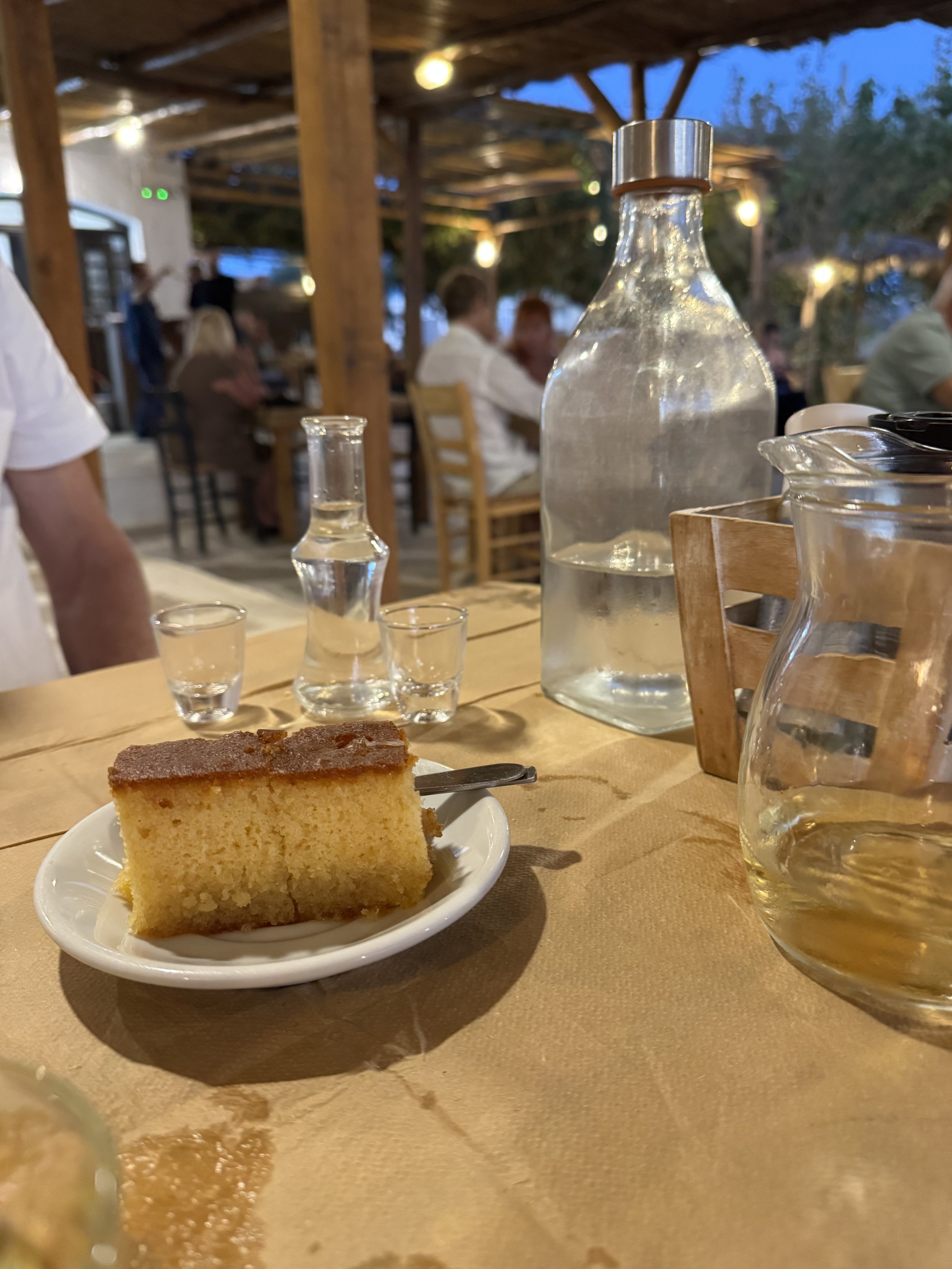
It has been the restaurants, where complimentary appetizers appear before we’ve even ordered, followed by a dessert and a little glass of liquor at the end of the meal, not because we asked for it, but simply because that is how guests are treated.
It has been sitting down at a simple, self-serve bakery, where a bottle of water is placed on the table and, almost immediately, a glass filled with ice is brought over for you.
It has been the line ups at restaurants, offering the waiting guest bottles of water as they wait for a table.
None of these gestures are extravagant. That’s what makes them so meaningful. Philoxenia isn’t about giving something expensive. It’s about making a stranger feel welcome. It is the feeling that there is always room at the table, something to eat, something to drink and someone willing to make you feel at home.
Perhaps that is why Crete can feel so much more than just a beautiful place to visit. There is something about being welcomed here, sometimes by people you’ve never met and may never see again that makes you feel, even briefly, as though you belong.
And maybe that is the enduring spirit of Zeus’s ancient law of hospitality: when a stranger arrives at your door, welcome them as though they might be a god, because you never know who has walked into your life.